


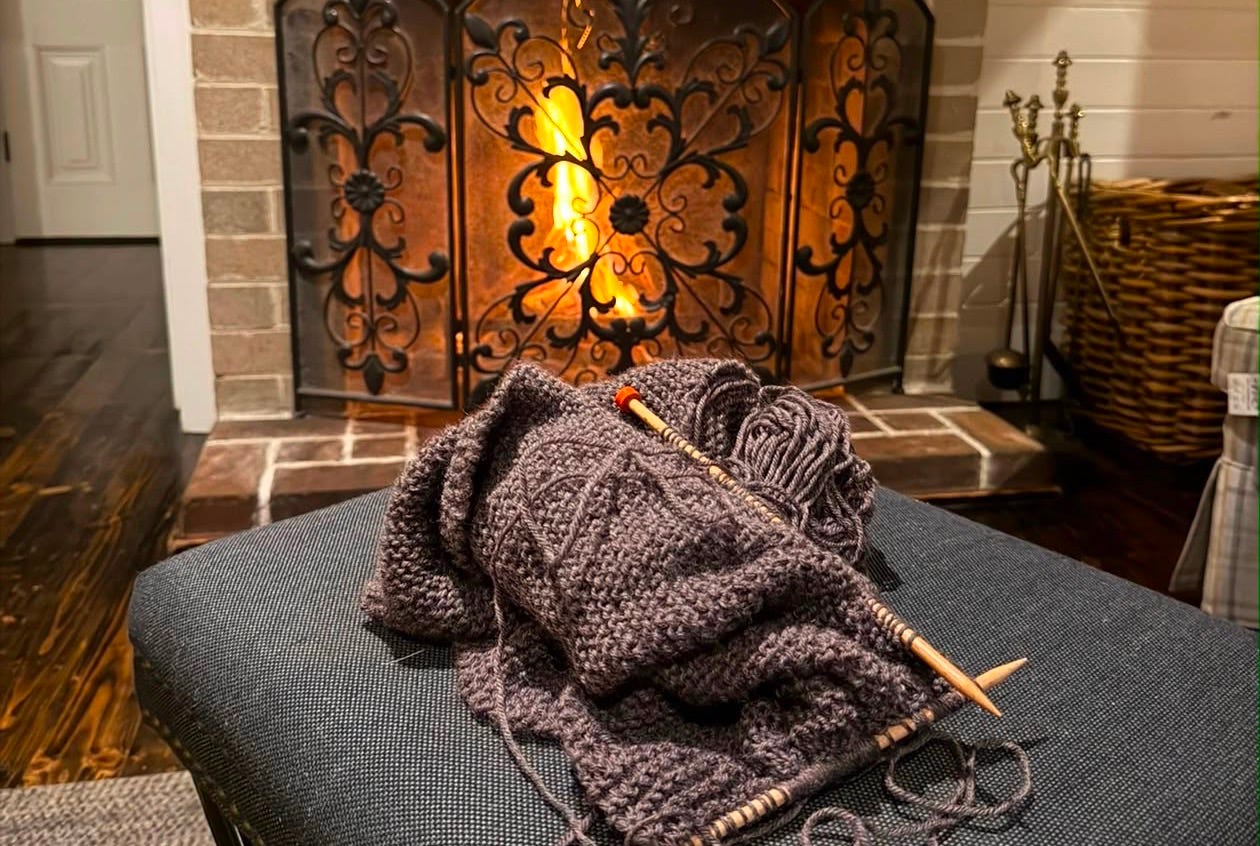
Evidence of my imperfect knitting. (It’s going to be a scarf - eventually)
Hello, my name is Julianna and I am a knitting addict.
There, I said it. I have started knitting, and I keep jokingly telling friends it’s my fun new addiction. The previous one involved my phone. The doom scroll kind - productive enough to feel justified or say ‘it’s for work’, but toxic enough to want to cut it.
The new addiction is not only wholesome but kind of strange. I am someone who checks her phone during films and considers a bath an unreasonable time commitment, and I am now choosing to spend precious weekend hours counting stitches.
I am, it turns out, not alone in this.
The ceramics class near my house has a three-month waitlist. The bread making instagram page has forty thousand followers. Something interesting is happening. I have been trying to work out what it’s all about.
The obvious explanation that everyone seems to be reaching for is AI fatigue. “Screen saturation”. There is something to all of that, but I think the more interesting thing to explore is what, exactly, people are moving toward.
The proof problem
In the past two years, digital output has lost something it used to have: a claim to credibility.
A photograph used to mean you were there. An essay used to carry the fingerprints of the person who wrote it: the way a mind moves, the sentence that gives something away, the thesis that took hours of research and years of critical thinking to formulate. We are past that now. The image could be generated. The essay could be from ChatGPT.
The problem this creates is partly practical, partly existential: when anything digital can be fabricated at scale, the only credential that cannot be questioned is something made by hand.
A scarf can’t be hallucinated.
There is nowhere to hide in knitting. Miss a stitch two rows back and it is there in the finished thing, recorded in the wool. The tension shifts as you go: tighter in the early rows, more relaxed as you lean what you’re doing. A machine would produce none of this. No inconsistency, no record of the person. Every imperfection is a timestamp. Proof that someone was here.
Sourdough proves you got up for three days in a row. A hand-thrown clay bowl carries the literal thumbprint of the person who made it. They are real in a way nothing generated can replicate, and right now, that quality is precious.
The attention problem
There is a second thing happening alongside this.
Analogue hobbies are screen-incompatible. You cannot knit and doom-scroll simultaneously. Believe me, I’ve tried,
The inability to multitask is the point.
Bread dough requires your hands. Pottery requires your hands, eyes and a tolerance for mess. We live in an environment designed to fragment attention, to deliver the next notification before we have processed the last. Choosing a hobby that punishes distraction is, in that context, a fairly deliberate act.
Psychologists call this flow state - the state of concentration so complete you lose track of time. It requires sustained attention matched against a task that is hard enough to matter. Screens break that condition by design. A pair of knitting needles does not.
Why now
The analogue hobby boom started as an aesthetic: cottage-core, ‘nonna-core’, slow living. Then it became a pandemic boredom response. Now it is something more durable. When the digital world becomes unreliable as evidence of anything, people go looking for proof they can hold onto.
We have been here before, in a way. Every generation produces a version of this: the return to the handmade as a response to acceleration. What is different this time is what the acceleration is replacing. Previous generations made things because machines were taking over physical labour. We are making things because machines are taking over thought.
These trends accelerated in the same window that generative AI went mainstream. The waitlists filled up the same year we stopped being able to trust the things in front of us. I do not think that is a coincidence.
To be clear: I use AI all the time and I love it. I am the last person to romanticise the pre-digital world. What I am observing is what happens to value when something becomes infinitely reproducible.
The scarf
So what now, you may ask. In twelve months, the thing you made with your hands will still exist. It will not have been updated or replaced by something a machine made faster. The scarf will have your tension in the yarn, too tight at the start and more relaxed by the end, because that is what learning looks like when it happens in the moment instead of in pixels.
Somewhere in that logic is the reason the ceramics class has a three-month waitlist, and people you would not have predicted are learning to knit.
The best cure for a screen addiction is, it turns out, a wool one.